How the World Avoided a Global IT Disaster (Again)
We revisit the original digital apocalypse — the year 2000 – looking back at what Y2K really was, how an army of COBOL coders saved the world before midnight, and why most people never even noticed.
But the clock is ticking again: Y2K38 is coming, and this time it’s 32-bit. Different date, same panic waiting to happen as UNIX time doesn’t heal — it overflows into a negative.
Listen now on Apple Music, Spotify, Deezer, Youtube or where-ever you get your panic attacks.
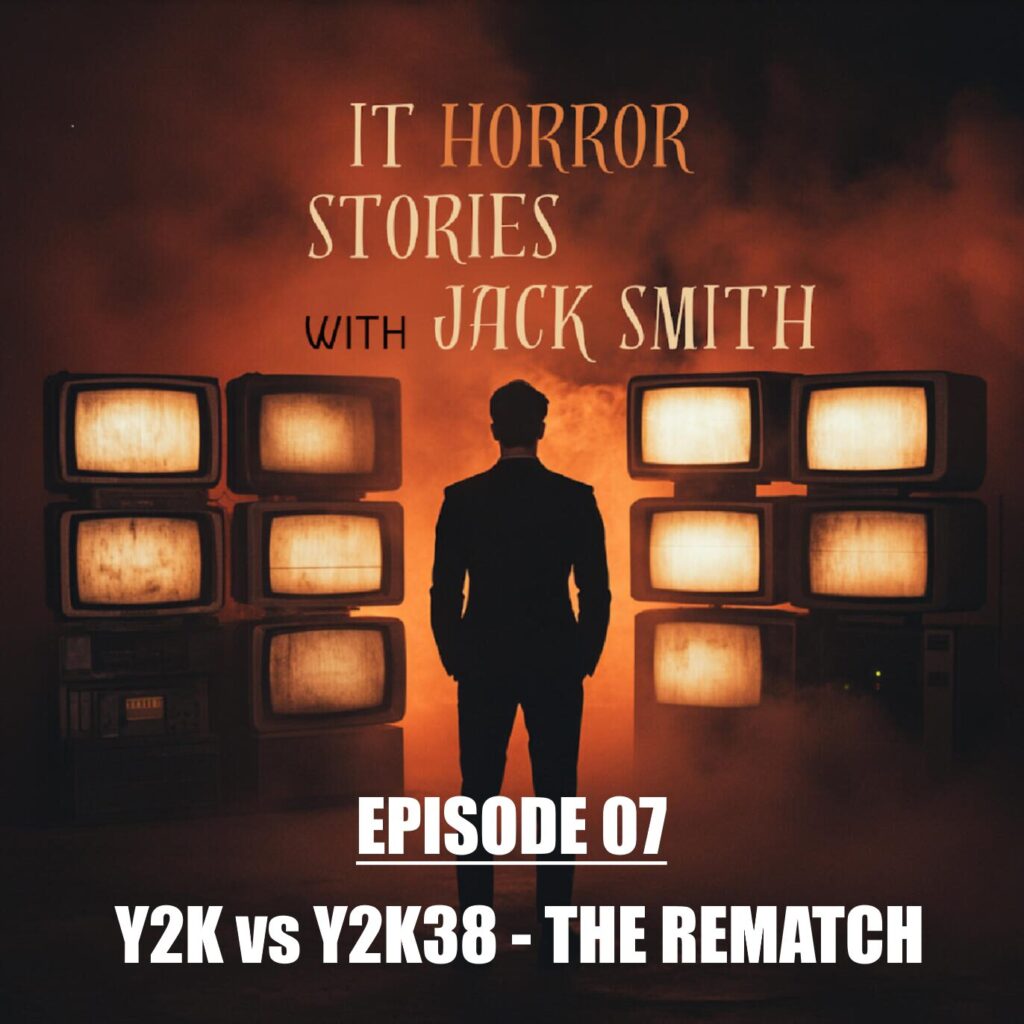
Y2K vs Y2K38: The Rematch No One Asked For
Welcome back, fellow tech travelers! If you’ve ever stayed up late wondering whether the world was going to end because of a computer bug—or if you’re just curious why so many IT folks have that faraway look when you say “January 1st, 2000”—this post is for you. Grab a coffee (or a floppy disk if you’re feeling retro), and let’s jump deep into the legends, laughs, and lessons of the Y2K bug, and why we’re heading into round two with the Year 2038 Problem (aka Y2K38).
And yes, for those keeping track, the “Rematch No One Asked For” might actually have a few sequels after that…
Setting the Stage: The Specter of Y2K
It’s hard to believe now, but there was a time when the biggest thing people worried about—especially in IT—was whether the calendar flipping from 1999 to 2000 was going to bring everything crashing down. Some called it the “Millennium Bug.” Some just stockpiled bottled water and canned beans.
As Jack Smith and Bob Johnson kicked off their chat in “IT Horror Stories,” they set the mood perfectly. The tone? Informal, direct, and seasoned with stories from the trenches. The vocabulary is friendly—nothing too technical unless it needs to be, and plenty relatable for anyone who’s tackled wonky software or worried about what midnight would bring.
“Where were you December 31, 1999?”
That’s the big question. For many of us, the answer involves a mix of parties, panic, and maybe a sneaky glance at the computer clock just after midnight.
What Was Y2K (And Why Did Everyone Freak Out)?
The Basics
So, why all the panic?
Back in the early days of computing, memory and storage were precious. Programs often saved years as two digits—“99” for 1999, “00” for 2000—figuring no one would ever care about dates decades in the future. Fast forward, and suddenly everyone did care. Would “00” get read as 1900? Would bank software mess up a 30-year mortgage? Would planes fall from the sky? Would VCRs start blinking uncontrollably? (Okay, maybe that last one was unrelated.)
What Was Supposed to Happen?
- Computers everywhere would fail at midnight
- Banks would lose decades of financial records
- Power grids would shut down
- Planes would fall out of the sky
- Your car might become confused and decide not to start
A lot of scary stuff—especially if you listened to the media or the guy trying to sell your city a giant water machine.
Taking Stock: What Actually Happened (aka “Waiting for Australia to Crash”)
Jack’s memory sums it up best. While some folks were panicking, he was out at a bar, pretty confident things would be okay. After all, Australia was twelve hours ahead. If they survived, maybe the rest of us would too.
And—spoiler alert—Australia did just fine.
“By noon December 31, we will know if Australia crashed or not. And Australia didn’t crash. Everything kept working.”
That pragmatic, slightly sarcastic optimism ran through a lot of IT shops that night. Yes, there were problems, but most were minor, caught, or mitigated by a wave of dedicated work earlier in the decade.
Why Didn’t Y2K Live Up to the Hype?
Decades of Hard (and Sometimes Thankless) Work
It turns out that most of the really scary issues got discovered far earlier—often by financial institutions. Think house loans written in the 70s and 80s with 25- or 30-year terms. Suddenly, the software starts wondering what on earth happens after December 31, 1999. The same goes for 99-year insurance policies.
A lot of organizations realized decades in advance they’d need to fix the problem. Some did—eventually. Others shrugged and figured it was a problem for “next guy.”
“I can imagine that the CIO in 1982 said, let this be the next guy’s problem.”
The Realities
- Desktop PCs sometimes didn’t know what date it was. (But Excel, not so much the hardware, was usually at fault.)
- Some registers thought it was 19100 or 1970.
- Most servers and mainframes had been patched.
- Fear outpaced reality.
It wasn’t just luck. It was years of work—sometimes decades—by IT folk who quietly fixed things, wrote test programs, sent out floppy disks, and tried to keep things running smoothly.
The Hype Machine: Fear, Preppers, and Monorails
Like any good horror story, it wasn’t just what might happen—it was what people thought might happen.
Jack and Bob talk candidly about the media-induced panic. Prepper movements got a big boost. Cities bought gear they didn’t need. And a few enterprising folks made a lot of money on the back of fear.
“I’m surprised we don’t have more monorails.”
There were Simpsons jokes, too, as well as a few eye rolls from the tech crowd.
But in the end, almost nothing dramatic happened—except a cash register or two. Mostly because the work to prevent disaster had already been done.
How IT Folks Cashed In (And What That Says About Software)
The Y2K effort sparked something else: a mini gold rush for consultants and programmers who could fix long-forgotten programs—sometimes for tens of thousands of dollars a day. If your business depended on software running reliably, and you hadn’t kept up to date… well, you were in trouble.
“That’s a tremendously great business model if I ever hear one.”
And in some cases, old mainframes lingered on well into the 2020s, because switching off was more expensive and riskier than keeping the (expensive) maintenance contracts going.
Living With, and Around, Old Tech
Mainframes are the workhorses of financial and big business computing. And as Jack and Bob point out, whether it’s a banking stack or a Boeing 747 weather computer, there’s good reason to stick with what works.
- Old tech may be slower, but it’s reliable.
- Upgrading introduces risk and unknowns—sometimes more than keeping the old systems running.
- Virtualization? Mainframes have been doing it for years.
The principle here is simple: If you really understand every quirk and edge case of a system, you can keep it running for decades. That can be safer than rushing to the “latest and greatest” if you don’t have to.
From Y2K to Y2K38: The Next Big Countdown
So, is history about to repeat itself? Maybe—kinda.
What’s the Year 2038 Problem (Y2K38)?
As the dust settled on Y2K, programmers rested easy. But lurking deep in the guts of UNIX systems is a second time bomb.
UNIX and its derivatives store time as the number of seconds since January 1, 1970 (“The UNIX Epoch”), using a signed 32-bit integer. The problem: Signed 32-bit integers can count about 2.1 billion seconds before they roll around and become negative.
The fateful moment? Sometime in January, 2038. The counter resets, and UNIX time jumps back to (wait for it)… 1901.
“And then your 2038 will become 1901. Because… this is how it works.”
Who’s at Risk?
- Embedded devices running old UNIX or Linux variants
- Old banking or scheduling systems using UNIX time
- Anything built on custom code that never got updated
- Insurance contracts, long-term policies, maybe even SAP systems with strange rollovers in 2048
Modern systems using up-to-date libraries are mostly safe—but only if they’re not stuck in “backwards compatibility mode.”
Lists: Classic Signs of an Impending IT Time Bomb
Let’s break down what separates a minor glitch from an all-out apocalypse (well, in IT terms).
Classic Signs:
- Software never gets updated, and the original authors have long moved on
- Systems depend on 30-year-old code because “it still works”
- Legacy code tucked away deep in frameworks everyone thought were safe
- Weird rollover moments—like SAP’s plan scheduling in 2048, or IBM mainframes ticking over in 2042
Standout Quote
“It’s literally as air gapped as you can have it. But not only that, you’ve been using it for so long, you know exactly what can go wrong and how to react to it.”
Is Y2K38 Just Another Overhyped Bug?
Maybe. Maybe not.
Bob jokes, “Honestly, I don’t know whether the hype will be comparable as the one in 1999 because there was much more public awareness of the fact that there was a new millennium.”
Back then, everyone was paying attention—countdowns, celebrations, even a bit of millennial optimism. In 2038? Hard to say. There might be more pressing things to worry about. Or maybe the fear-peddlers will just dust off their playbooks for another round.
Frameworks, Open Source, and Modern Lessons
Here’s a practical takeaway for today’s developers: If you’re building a new project, lean on well-supported frameworks and open source libraries. The bigger the community, the quicker problems are surfaced and fixed.
If you try to outsmart everyone and do it all yourself, you might create more problems down the road—especially ones that creep up decades later.
“If you think you can do it better yourself, perhaps you can, but you won’t be protected for those type of things that you might not have accounted for.”
What About After 2038? The Roadmap of Time Bugs
Just when you think you’re safe after Y2K38, some gadgets and systems out there have even stranger time rollover glitches looming:
- SAP scheduling rolls over in 2048
- IBM mainframe time-of-day clock rolls over in 2042
- Some embedded bits will need upgrades as they run out of storage for their counters
It’s not just one looming problem—it’s a string of “next guy’s problems,” spaced every couple of decades.
“If you look at an average IT career of like 20, 25 years quite often then yeah, that is three, four guys managing that software stack and then it is basically upon future grandchildren to fix.”
Who’s Really Affected, and Who’s Not?
Many big banking institutions still run mainframes, which aren’t affected by the UNIX time bug. Heavy industry, embedded machinery, maybe—but even then, most modern systems are being upgraded (or will be).
If you’re deploying something new on Linux, as long as you use up-to-date kernels and libraries, you should be safe. Just don’t get clever and use a really old “backwards compatible” mode for your time handling.
If you think your company is at risk, now’s the time to check your stack and see where you’re exposed.
The Big Takeaways: What We Learned from Y2K (and What We Should Do for Y2K38)
Here’s the simple truth: These time bugs rarely wreck the world. But they can make local messes, cost lots of money, and create headaches for teams who ignored them or kicked the can down the road.
Guidelines for Staying Sane:
- Don’t Panic: Community fixes usually appear far ahead of time.
- Keep Your Systems Updated: Use supported libraries and frameworks.
- Don’t Get Fancy (Unless You Have To): Avoid clever time tricks.
- Ask Around: Chances are, someone else has faced the same challenge.
- Look for Obscure Rollover Dates: Check long-term contracts, loans, insurance, and plan scheduling.
- Use Visuals and Documentation: Future-you will thank you.
What’s Next? The Endless Parade of Bugs
From Y2K to Y2K38, then 2042, 2048, even 2069 and beyond—time bugs aren’t going away. Each generation of IT will wrestle with their own flavor. The world won’t end, but someone will have a long night debugging code written before they were born.
Final Standout Quote:
“Some stupid thing like a second counter can come back to haunt you literally 68 years later. Okay, let this be the next guy’s problem and then very likely the next guy of the next guy’s problem.”
Wrapping Up: Don’t Fear the Bug—Learn from It!
Whether it’s 1999, 2038, or some wild day in 2049, the secret isn’t magic—just good, old-fashioned preparation and a little humility. Most of the time, someone else has already fixed the problem, or at least written some code you can borrow.
So keep your head up, check your code, and remember: The best time to prepare for a time bug is now—and the worst is “Let this be the next guy’s problem.”
Until next time, keep your BIOS happy, your kernels patched, and your sense of humor intact.
Cheers and Good Luck Until the Next Time Bomb
Thanks for tuning in—whether you lived through the drama firsthand or are just gearing up for the next round. The real “horror story” is thinking it only happens once… so keep your frameworks sturdy and your team caffeinated!
See you in the next episode.
“We have frameworks. They are very well supported. And the more supported that they are, the more widespread that they are, the quicker they will be fixed if they discover something.”


Leave a Reply